
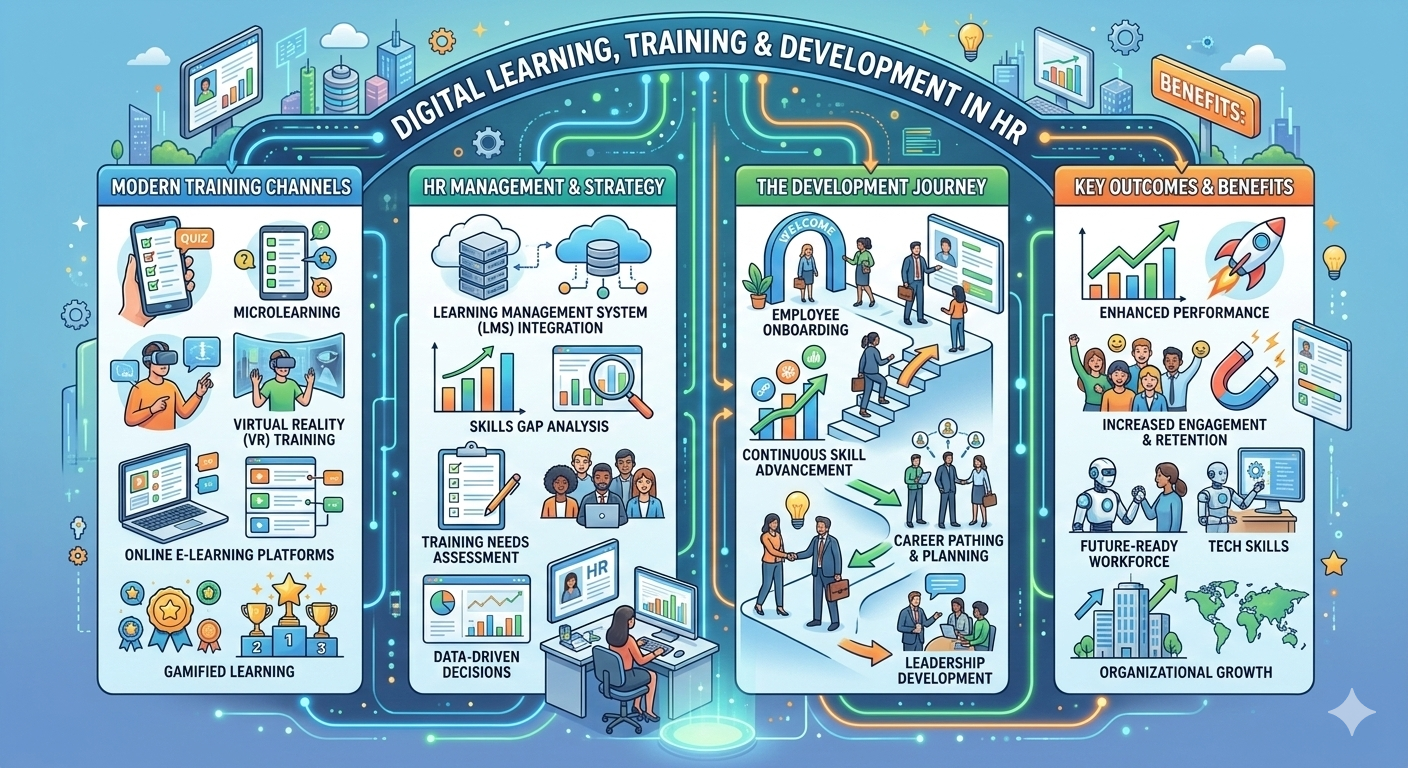
The Evolution of Workforce Development:-
In today’s fast-evolving business landscape, Digital Learning, Training, and Development (L&D) has become a cornerstone of strategic Human Resources. Moving beyond traditional classroom settings, HR is now leveraging technology to deliver engaging, accessible, and personalized learning experiences. This transformation ensures employees acquire relevant skills continuously, fostering a culture of lifelong learning that directly impacts organizational agility, employee retention, and overall productivity. Effective content on this topic must emphasize innovation, flexibility, and the measurable impact on talent growth.
Key Pillars of Digital L&D :-
The strength of digital L&D lies in its ability to cater to diverse learning styles and schedules. HR departments are deploying various tools: Learning Management Systems (LMS) serve as central hubs for content, e-learning modules offer self-paced education, and webinars/virtual classrooms facilitate interactive group sessions. Beyond formal training, microlearning delivers bite-sized content for immediate application, while gamification boosts engagement. This approach fosters a culture of continuous development, where employees actively manage their growth. Content should underscore how these digital modalities support upskilling and reskilling, keeping the workforce competitive and adaptable.
Digital Learning, Training, and Development in HR :-
| Keyword Point | Content Explanation |
| Learning Management System (LMS) | A software application for the administration, documentation, tracking, reporting, automation, and delivery of educational courses or training programs. Explanation: The central hub for all digital learning, allowing HR to manage content, track progress, and analyze training effectiveness. Examples include Cornerstone OnDemand, Workday Learning. |
| E-learning Modules | Self-paced, interactive online courses that can include multimedia, quizzes, and simulations. Explanation: Offers flexibility and consistency, allowing employees to learn at their own pace and revisit material, ensuring uniform understanding across the organization. |
| Microlearning | Delivers short, focused content (2-5 minutes) designed to achieve a specific learning objective, often via mobile devices. Explanation: Addresses short attention spans and immediate knowledge needs, perfect for just-in-time learning and reinforcement of concepts without overwhelming learners. |
| Gamification | Applying game-design elements and game principles in non-game contexts, such as training, to improve user engagement, productivity, and learning. Explanation: Introduces points, badges, leaderboards, and challenges to make learning more fun and motivating, increasing participation and completion rates. |
| Virtual Classrooms / Webinars | Live, online training sessions conducted by an instructor, allowing real-time interaction, Q&A, and collaborative activities. Explanation: Replicates the benefits of in-person training with the convenience of remote access, ideal for interactive workshops and expert-led sessions. |
| Adaptive Learning | Learning paths that adjust in real-time based on an individual’s performance, strengths, and weaknesses, powered by AI. Explanation: Creates highly personalized learning journeys, ensuring employees focus on areas where they need improvement, optimizing learning efficiency. |
💻 Pros and Cons of Digital L&D:-
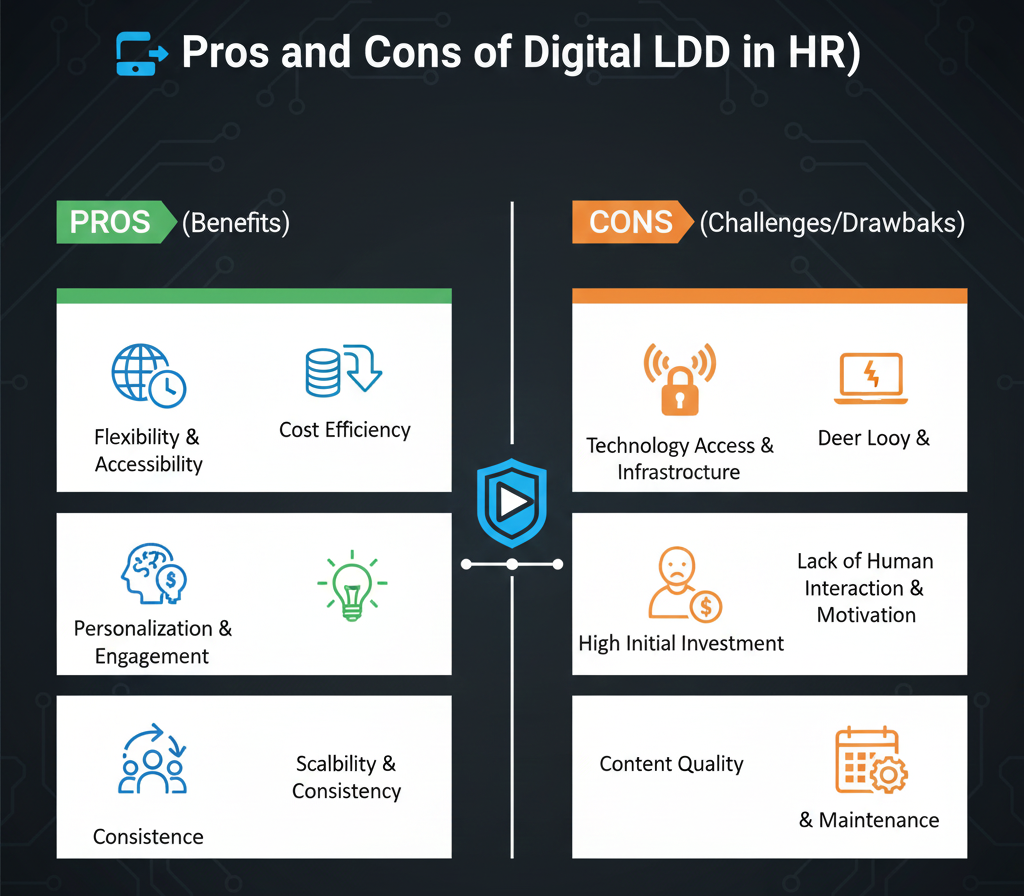
| Pros (Benefits) | Cons (Challenges/Drawbacks) |
| Flexibility and Accessibility | Technology Access and Infrastructure |
| Employees can access training anytime, anywhere, on any device. This is crucial for remote or global teams and allows for learning during non-working hours. | Requires a stable internet connection and adequate devices (laptops, tablets). Employees in remote locations or with limited access may be excluded. |
| Cost Efficiency | High Initial Investment |
| Significantly reduces costs associated with travel, physical materials, venue rentals, and instructor fees common in traditional training. | Setting up a robust LMS (Learning Management System), creating high-quality interactive e-learning modules, and licensing content requires a substantial upfront budget. |
| Personalization and Engagement | Lack of Human Interaction and Motivation |
| Adaptive learning and personalized paths (AI-driven) ensure training is relevant to individual roles and skill gaps, leading to higher engagement and better retention of knowledge. | Some learners thrive on face-to-face interaction, immediate human feedback, and group dynamics. Digital learning can sometimes feel isolating, leading to lower completion rates. |
| Scalability and Consistency | Content Quality and Maintenance |
| Training can be rolled out instantly to thousands of employees globally, ensuring uniform content and consistent messaging across the entire organization. | Creating truly engaging and effective digital content (especially video and simulations) is challenging. Content quickly becomes outdated and requires continuous, costly maintenance. |
| Data and Analytics | Digital Fatigue and Screen Time |
| HR can easily track and measure key metrics (completion rates, test scores, time spent) through the LMS, allowing for ROI calculation and data-driven program improvement. | Too much reliance on screen-based learning can lead to eye strain, distraction, and ‘digital fatigue,’ diminishing the effectiveness of the training. |
Conclusion: Cultivating a Learning-Driven Culture :-
Digital learning, training, and development are no longer optional but essential for building a resilient workforce. By embracing diverse digital tools and strategies, HR empowers employees with accessible, engaging, and relevant growth opportunities. This shift cultivates a learning-driven culture that fosters continuous skill enhancement, adaptability, and high performance. Ultimately, digital L&D is a strategic investment that not only future-proofs the workforce but also significantly boosts employee engagement and organizational innovation.